
THE REVIEWER GUIDE
A partial view.
A possible bigger picture.
A look inside RiftBuddy’s tile-comparison work: spot recurring room geometry, question uncertain matches and help build a more accurate map library.
Informational preview · public review submissions are not open
FROM OUR RECORDED MAP EXPERIMENT
Seen walls. Predicted continuation.
On the left, a partially explored Halls of Agony room: only part of its wall geometry is visible. On the right, the same moment with a matching room outline from the library. Gray dotted walls show where that room may continue into the fog of war.
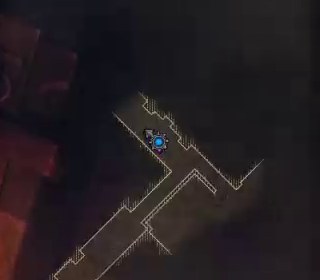
Recorded prototype example, shown at the same scale and orientation. The prediction paths come from that replay moment; no walls were erased to simulate fog. Matching a visible segment does not prove every unseen wall or connector. Future observations and human review must check the proposed continuation. This page does not record a verdict.
The visible structure supports the match. Hidden extensions still need confirmation.
An observed wall, opening or room structure contradicts the proposed match.
Too little is revealed to distinguish this room from another plausible candidate.
Look beyond a familiar corner.
Compare the room’s overall shape, internal structures and connectors. A small repeated motif can occur in more than one tile. Tiles keep their orientation; rotating a similar shape is not evidence of a match.
Hatched shading may be decorative. A gap may be obscured or unexplored. “Cannot tell” is a useful answer, and a whole reusable region can extend beyond what one image shows.
A judgement that can be revised.
The existing private tools let reviewers compare images, align geometry and mark approximate tile boundaries. Those markings guide investigation; they are not automatically treated as exact wall coordinates.
Review revisions and their source examples need to remain traceable. A confirmed-looking match still needs checks against other floors and false-match examples before it supports wider predictions.
WHAT COMES NEXT
Human review, built into the workflow.
Our goal is to bring this capability into the RiftBuddy infrastructure: collect useful observations locally, prepare a focused comparison, invite a human judgement and test the resulting change against other evidence.
- Prepare a small, clear task.
Show relevant map geometry and the question that needs answering, with context for incomplete coverage.
- Capture an independent judgement.
Support Same, Different and Cannot tell, with room for boundary corrections and later revisions.
- Validate before updating the library.
Keep human reviews separate from algorithm suggestions and compare results across distinct floors. A review should not silently alter someone’s live map.
This is a planned public workflow, illustrated with existing private lab imagery. There is no public review queue, reviewer account or review-submission form on this page yet.
Follow review-tool development →Looking to test your PC instead?
The compatibility checker is a separate, publicly available tool. It measures selected hardware and recorded-processing behavior; it does not ask you to label maps.
PC compatibility checker guide →